
Why Do I Shut Down During Conflict? Trauma, Attachment & the Freeze Response
Why Do I Shut Down During Conflict? Trauma, Attachment & the Freeze Response
You know what you want to say. But then the conversation gets tense. Your partner seems frustrated. Their tone changes. Maybe you feel criticized, misunderstood, rejected or blamed. Suddenly, the words disappear. Your mind goes blank. Your body becomes tense or numb. You might stop talking, say “I don’t know,” leave the room or feel an overwhelming need for the conversation to end.
Then, hours later, you know exactly what you wanted to say.
If you frequently shut down during conflict, it doesn’t necessarily mean you don’t care about the relationship or that you are intentionally avoiding communication. For some people, emotional shutdown can be connected to nervous system activation, attachment patterns, previous relationship experiences or trauma.
At Soma Clinical Counselling in North Vancouver, we often work with people who understand their relationship patterns intellectually but find that their bodies respond very differently when conflict, rejection, criticism or emotional disconnection occurs.
Understanding why you shut down can be an important first step toward responding differently.

Shutting down during conflict can sometimes be a protective response when the nervous system becomes overwhelmed.
What Does Shutting Down During Conflict Look Like?
Emotional shutdown can look different from person to person. For some people, it is obvious. They stop talking or physically leave. For others, the shutdown happens internally while they continue sitting in the conversation.
You might notice yourself:
Going completely quiet during an argument
Saying “I don’t know” even when you know you have feelings about what happened
Struggling to find your words
Feeling mentally blank
Becoming numb or disconnected
Avoiding eye contact
Wanting to leave the conversation
Feeling suddenly exhausted
Becoming irritated or angry
Feeling like you “don’t care anymore”
Replaying the conversation afterward
Thinking of everything you wanted to say hours later
Avoiding the topic because you don’t want another argument
Sometimes emotional shutdown during conflict can resemble a freeze response, particularly when the nervous system experiences criticism, anger, rejection or emotional intensity as threatening.
The important question becomes less: “Why am I so bad at communicating?” and more: “What happens inside me when communication starts to feel unsafe?”
Why Does My Mind Go Blank During Arguments?
One of the most frustrating experiences people describe in therapy is knowing they have something to say but suddenly being unable to access it during conflict.
You might think:
Why can’t I just explain myself?
Why can I think clearly afterward but not during the argument?
Why do I completely shut down when someone is upset with me?
When the nervous system detects threat, our attention can shift toward protecting ourselves.
And “threat” does not only mean physical danger.
For some people, relational experiences such as rejection, criticism, disappointment, anger, abandonment or feeling misunderstood can create significant nervous system activation.
You may logically know: “My partner and I are having a disagreement.” But your body may be responding with: “Something bad is about to happen.”
When emotional activation becomes intense enough, accessing language, reflection and vulnerability can become much more difficult.
Is Shutting Down During Conflict a Trauma Response?
Sometimes, but not always. Shutting down during an argument does not automatically mean someone has experienced trauma.
However, our previous relational experiences can influence how our nervous systems respond to conflict today.
For example, imagine growing up in an environment where:
Anger was unpredictable
Expressing emotions resulted in criticism
Speaking up made situations worse
You were expected to keep the peace
Your feelings were dismissed
Conflict never resulted in meaningful repair
You had to manage another person’s emotions
You were frequently blamed
You learned to “be the bigger person”
Emotional safety depended on staying quiet
Your nervous system may have learned that withdrawing, becoming quiet, appeasing someone or disconnecting helped reduce conflict. Those responses may have been adaptive at the time.
Years later, similar feelings can emerge in adult relationships, even when the circumstances are different.
For some people seeking trauma therapy in North Vancouver, the work therefore goes beyond simply learning communication techniques. Therapy may also involve understanding why particular relationship experiences create such powerful emotional and physiological reactions.
Fight, Flight, Freeze and Fawn in Relationships
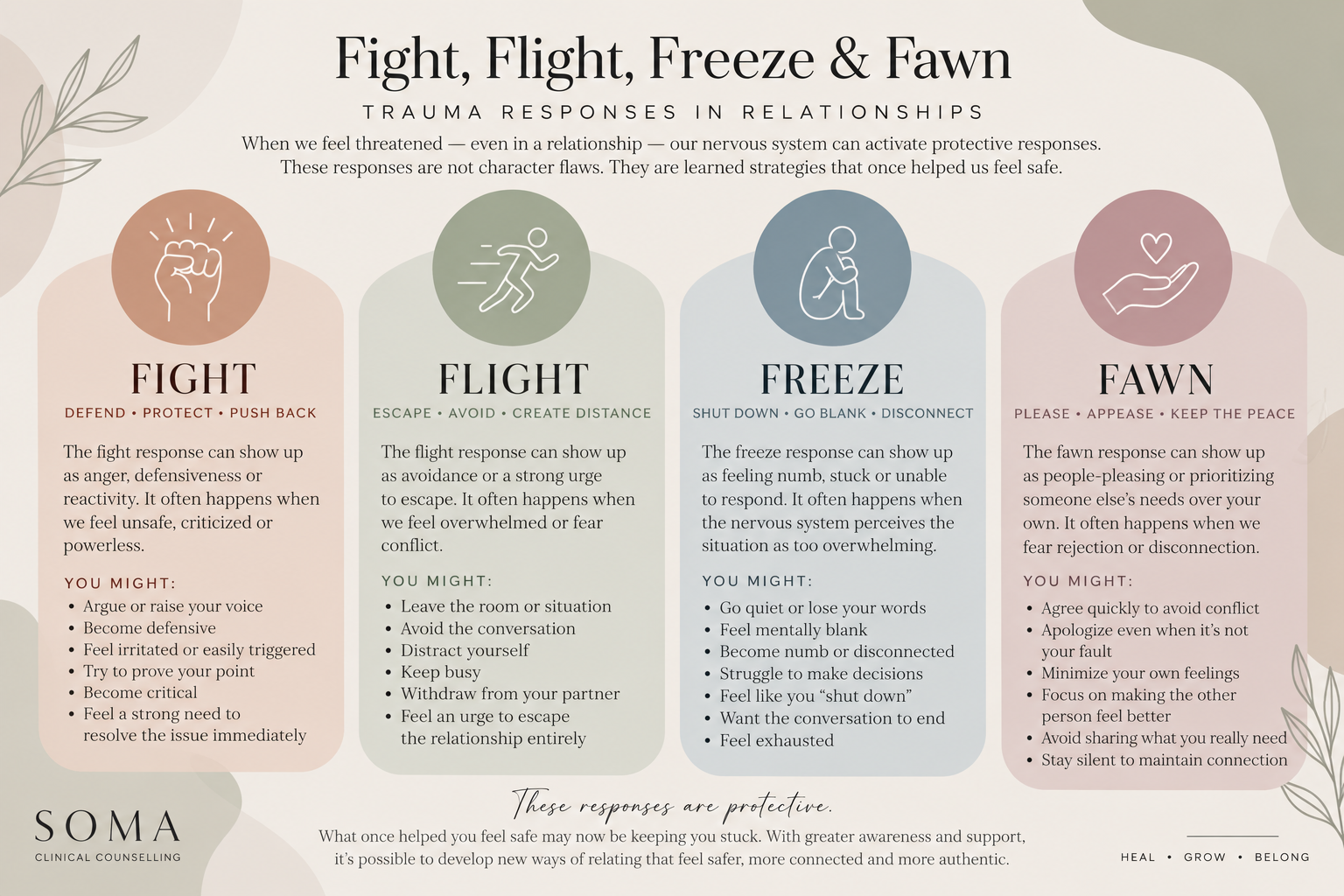
When people think about trauma responses, they often imagine reactions to obvious danger. But fight, flight, freeze and fawn responses can also appear within relationships.
Fight
You may:
Argue
Become defensive
Raise your voice
Try to prove your point
Become critical
Feel an intense need to resolve the issue immediately
Flight
You may:
Leave the room
Avoid the conversation
Distract yourself
Become extremely busy
Avoid your partner afterward
Feel an urge to escape the relationship entirely
Freeze
You may:
Go quiet
Feel numb
Lose your words
Feel disconnected from your body
Struggle to make decisions
Feel mentally blank
Fawn
You may:
Agree to end the conflict
Apologize quickly
Minimize your feelings
Focus on making the other person feel better
Abandon your own boundary
People-please to restore connection
These responses are not necessarily fixed personality traits. You might fight in one relationship, freeze in another, and move between several responses depending on the situation.
Why Do I Feel Like a Child During Arguments?
Have you ever been in an argument and thought: “Why do I suddenly feel so small?”
Sometimes a present-day relationship experience can activate emotions, expectations or bodily responses connected to much earlier experiences.
For example:
Your partner criticizes you and suddenly you feel like you can’t do anything right.
Someone raises their voice and your body freezes.
Your partner withdraws and you experience intense fear that the relationship is ending.
Someone tells you that you are overreacting and you immediately begin questioning whether your feelings are valid.
Someone becomes disappointed in you and you feel responsible for making everything okay.
The intensity of the emotional reaction may feel confusing because it seems larger than the immediate situation.
Sometimes people describe this experience in therapy by saying: “I know I’m an adult, but suddenly I feel like I’m a kid again.”
Attachment-focused therapy can help explore what a present interaction represents emotionally, rather than focusing only on the surface-level disagreement.

Present-day relationship conflict can sometimes activate emotional patterns connected to earlier experiences.
How Childhood Experiences Can Affect Adult Relationships
Our earliest relationships can influence what we learn about emotional safety, vulnerability, conflict and connection.
A child might learn:
“It’s safer not to say anything.”
“I need to keep everyone happy.”
“If someone is upset, I need to fix it.”
“My feelings create problems.”
“I have to be the bigger person.”
“If I express what I need, I might be rejected.”
“I have to handle things myself.”
Children usually do not consciously decide to develop these beliefs. Instead, they adapt to their relational environments. Over time, these adaptations can become automatic protective strategies. Then adult relationships can activate them.You may desperately want to communicate with your partner while another part of you is saying:
Don’t say anything. It will only make things worse.
Attachment Styles and Conflict
Attachment theory can provide another framework for understanding relationship conflict.
Attachment patterns are not about determining which partner is “the problem.” They can help us understand the strategies people use when connection feels uncertain or threatened.
Anxious Attachment During Conflict
Someone experiencing anxious attachment patterns may:
Seek reassurance
Want to resolve conflict immediately
Become highly sensitive to emotional distance
Repeatedly revisit conversations
Fear abandonment
Interpret withdrawal as rejection
Avoidant Attachment During Conflict
Someone experiencing avoidant attachment patterns may:
Need significant space
Become overwhelmed by emotional intensity
Minimize the problem
Withdraw
Struggle to identify or communicate vulnerable emotions
Experience repeated requests for conversation as pressure
Fearful-Avoidant Attachment During Conflict
Someone may simultaneously crave closeness and fear vulnerability.
This can create an experience of:
“Please come closer—but now this feels too vulnerable, so I need to get away.”
Importantly, people are more complex than attachment labels.
Attachment therapy is not simply about determining your “attachment style.” It can involve understanding what happens when connection feels threatened, what you learned to do to protect yourself and what you actually need underneath those protective responses.
The Pursuer-Withdrawer Relationship Cycle
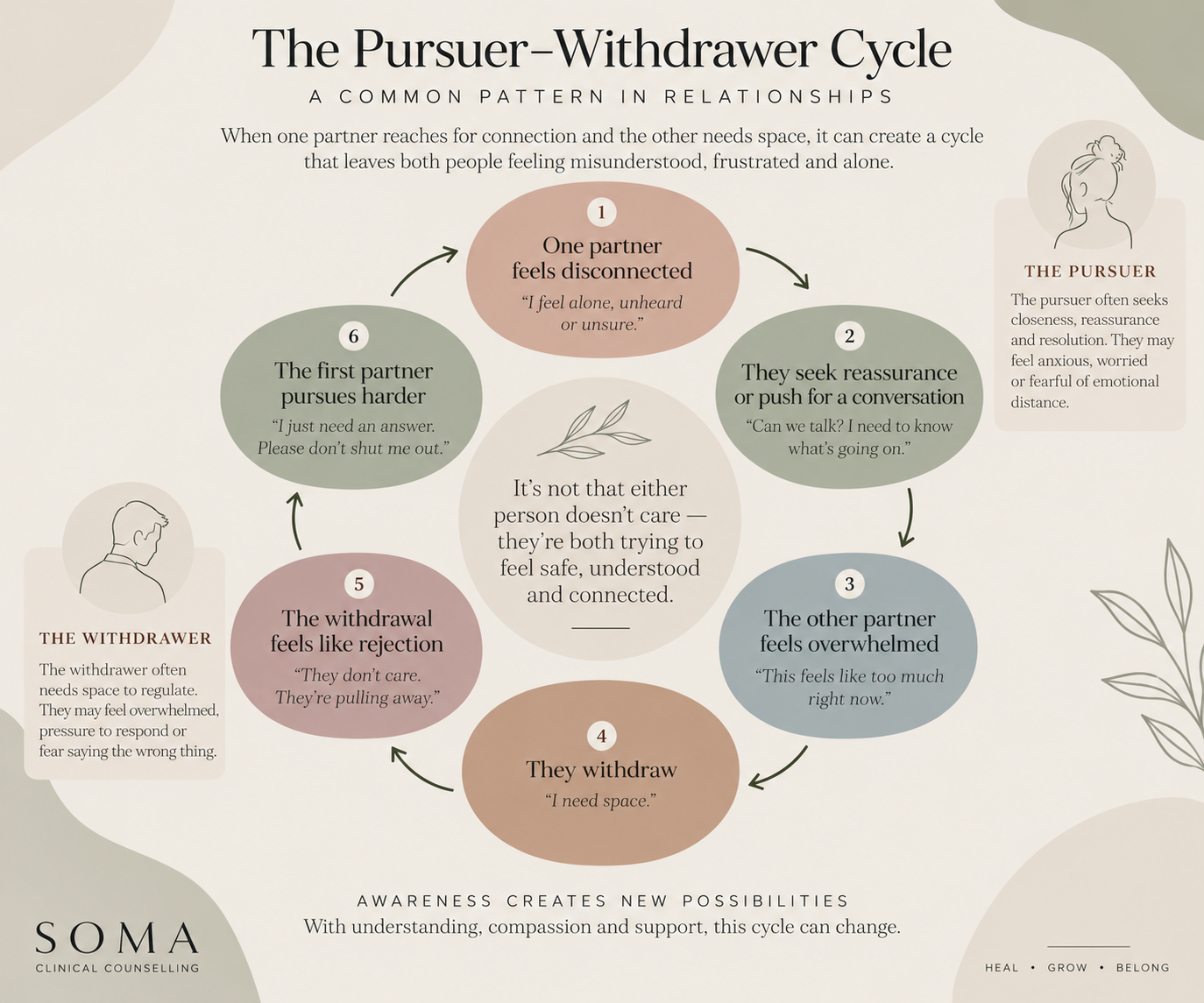
One common pattern in relationships is the pursuer-withdrawer cycle.
It might look like this:
One partner feels disconnected
↓
They seek reassurance or push for a conversation
↓
The other partner becomes overwhelmed
↓
They withdraw
↓
The withdrawal feels like rejection
↓
The first partner pursues harder
↓
The second partner becomes even more overwhelmed
↓
They withdraw further
Eventually, both people can feel completely misunderstood.
One partner may be thinking:
“You don’t care enough to talk to me.”
While the other is thinking:
“Nothing I say is ever going to make this better.”
Neither person necessarily wants the disconnection.
They have become caught in a cycle that continually reinforces itself.
Why Do I Withdraw When I’m Hurt?
Withdrawal is sometimes interpreted as indifference. But withdrawal can happen precisely because someone does care.
Underneath “I’m done talking about this” might be:
“I’m scared you’re not going to understand me.”
“I don’t know how to explain what I’m feeling.”
“If I keep talking, I’m going to get blamed.”
“I’m afraid I’m going to say something I regret.”
“I’m overwhelmed.”
“I don’t think anything I say will make a difference.”
“I’m scared this conversation is going to end our relationship.”
Sometimes withdrawal is not the absence of emotion. It can happen because there is too much emotion and not enough perceived safety to express it.
Why Anger Can Protect More Vulnerable Emotions
Anger is important. It can tell us that something feels unfair, that a boundary has been crossed or that something needs our attention. But sometimes anger also protects emotions that feel much harder to experience.
Underneath anger might be:
Hurt.
Fear.
Rejection.
Shame.
Helplessness.
Loneliness.
Someone might say: “Whatever. I’m done.” While underneath there may be something much more vulnerable: “I don’t want to find out that my feelings don’t matter to you.” Understanding what sits underneath anger can create new possibilities for communication.
How to Stop Shutting Down During Conflict
Changing emotional shutdown usually takes more than simply telling yourself to communicate better. Start by becoming curious about what happens before the shutdown.
1. Learn Your Early Warning Signs
Notice your body.
Maybe your heart starts racing.
Your chest tightens.
Your face becomes hot.
Your thoughts speed up.
Or perhaps the opposite happens, you become numb, tired or mentally blank.
Recognizing activation earlier gives you more opportunity to respond intentionally.
2. Name What Is Happening
Instead of disappearing from the conversation, you might practice saying: “I want to talk about this, but I can feel myself getting overwhelmed.” Naming the experience can help both partners understand that needing a pause does not necessarily mean abandoning the conversation.
3. Take a Structured Pause
Sometimes regulation needs to happen before resolution. A pause could sound like: “I need 30 minutes to settle. Can we come back to this at 7?” The important piece is returning to the conversation when possible.
4. Ask What Is Underneath the Protection
Instead of stopping at: “I’m angry.” Try asking: “What about this hurts?” Maybe the answer is: “I feel like you’re not listening to me.” Or: “I’m scared you’re going to leave.” Or: “I feel like I’m the problem again.”
5. Communicate the Underlying Need
A protective reaction might say: “You never listen to me.”
The underlying need might sound more like: “I need to know that you understand why this hurt me before we try to solve it.”
That shift can change the emotional conversation.

Recognizing nervous system activation can create more space to communicate the emotion underneath the shutdown.
How Attachment Therapy Can Help With Relationship Patterns
You do not need to wait until your relationship is in crisis to explore attachment patterns.
Attachment therapy in North Vancouver can help individuals better understand recurring experiences involving:
Fear of rejection
Emotional shutdown
Conflict avoidance
People-pleasing
Reassurance seeking
Difficulty setting boundaries
Fear of abandonment
Difficulty expressing needs
Feeling responsible for other people’s emotions
Repeating similar relationship patterns
Rather than simply asking, “How do I stop doing this?”, attachment-focused therapy may also explore: “What is this response protecting me from?” That question can open the door to a much deeper understanding of your emotional world.
Trauma Therapy and Nervous System Regulation
For some people, relationship patterns are closely connected to trauma or earlier experiences of emotional insecurity.
Trauma-informed counselling can help you recognize when your nervous system becomes activated, understand your protective responses and develop greater capacity to remain connected to yourself during emotionally difficult experiences.
Depending on your individual needs and therapist, approaches may include attachment-focused therapy, Emotionally Focused Individual Therapy (EFIT), somatic therapy, EMDR, Brainspotting and other trauma-informed approaches.
The goal is not to become someone who never gets triggered. The goal can be learning to recognize what is happening, understand what your nervous system is trying to protect you from and develop more choice in how you respond.
Individual Relationship Counselling vs. Couples Therapy
You do not necessarily need your partner to attend therapy in order to work on relationship difficulties.
Individual relationship counselling may be helpful if you want to explore:
Your attachment patterns
Why you repeatedly choose certain relationship dynamics
Boundaries
Rejection sensitivity
Communication
People-pleasing
Emotional regulation
Fear of abandonment
Relationship anxiety
Difficulty trusting
Identifying what you actually need from a relationship
Couples therapy, on the other hand, allows both partners to work directly on the cycle happening between them.
This might include communication, emotional connection, trust, intimacy, conflict, attachment needs and repair after relationship injuries.
Both can be valuable. The appropriate approach depends on what you are experiencing and what you hope to change.
When Should I Consider Therapy for Relationship Patterns?
You might consider counselling if:
You repeatedly shut down during conflict
Arguments leave you feeling panicked, numb or emotionally exhausted
You understand your relationship pattern but cannot seem to change it
You repeatedly feel rejected or abandoned
You struggle to communicate needs or boundaries
You frequently feel responsible for keeping everyone happy
Childhood experiences seem to resurface during adult relationships
You repeatedly find yourself in similar relationship dynamics
You want to understand your attachment patterns more deeply
Relationship stress is affecting your mental health or daily life
Therapy can provide space to slow these patterns down and understand what is happening underneath them.
Attachment & Trauma Therapy in North Vancouver
At Soma Clinical Counselling, our therapists provide attachment-focused and trauma-informed counselling in North Vancouver and online across British Columbia.
We work with individuals and couples navigating trauma, attachment wounds, relationship difficulties, anxiety, ADHD, emotional disconnection, recurring conflict patterns and other mental health concerns.
Our team draws from approaches including attachment-based therapy, Emotionally Focused Therapy and EFIT, somatic approaches, EMDR, Brainspotting, Gottman-informed couples therapy and other evidence-informed modalities depending on therapist training and client needs.
If you recognize yourself in the experience of shutting down during conflict, therapy can help you move beyond simply asking, “Why do I keep doing this?” and begin understanding what your nervous system and attachment system may be trying to communicate.

Looking for attachment therapy, trauma therapy or relationship counselling in North Vancouver?
Learn more about Soma Clinical Counselling, explore our therapists, or book a 20-minute consultation to find the right fit for you.